
.jpg)










How much can I borrow on a buy-to-let mortgage?
Most UK lenders determine borrowing based primarily on rental income and Loan-to-Value (LTV). Standard buy-to-let mortgages typically offer up to 75% LTV, although some lenders offer 80% LTV products. The amount you can borrow ultimately depends on rental income, interest rates, lender stress tests and ownership structure.
The United Kingdom’s private rented sector requires investors to master the precise mechanics of commercial property finance to scale successfully. The most fundamental question posed by both new and experienced property investors is: how much can I borrow buy to let?
Unlike standard homeownership loans, the answer cannot be found by simply multiplying a personal salary. In the investment sphere, borrowing capacity is a dynamic calculation dictated by the underlying asset's commercial performance. Mortgage lenders evaluate applications by focusing primarily on four crucial pillars: the property's gross rental income, the Loan-to-Value (LTV) ratio, prevailing internal stress-test interest rates, and the borrower’s overarching financial profile and corporate structure.
Their core objective is risk mitigation, ensuring the asset generates enough capital to perpetually service its own debt. This comprehensive guide details exactly how lenders calculate borrowing limits, explaining the metrics that dictate your purchasing power and outlining how to secure the maximum buy to let mortgage without over-leveraging your portfolio.
For a foundational overview of the wider investment landscape, explore the core platform at Unity Property Investment.
Executive Summary
Securing the optimal buy-to-let mortgage requires a strategic understanding of how commercial lenders assess risk and affordability. Unlike residential mortgages, your borrowing power is not determined by your personal salary, but by the financial performance of the property itself and how you structure the investment.
- Rental Income is the Primary Driver: Lenders use an Interest Coverage Ratio (ICR) to ensure the property's rent comfortably covers the mortgage interest. Higher rental yields directly translate to higher borrowing limits.
- LTV Limits Cap Your Borrowing: While strong rent supports higher loans, lenders strictly cap the Loan-to-Value (LTV) ratio based on risk. A 75% LTV remains the industry standard for balancing optimal interest rates and leverage.
- Rigorous Stress Testing: Banks apply hypothetical "stress rates" (often higher than your actual mortgage rate) to calculate your maximum borrowing limit, protecting their capital against future market fluctuations.
- Ownership Structure Matters: Purchasing through a Limited Company (SPV) routinely unlocks higher borrowing limits. Lenders apply a more generous 125% ICR threshold to SPVs, compared to the strict 145% applied to higher-rate taxpayers borrowing in their personal names.
How Buy-to-Let Borrowing Differs from Residential Mortgages
The foundational difference between securing a residential mortgage and a buy-to-let mortgage lies in the underwriting philosophy employed by the financial institution.
When an underwriter assesses a standard residential mortgage application, they focus primarily on the applicant's personal income streams. They apply a predetermined multiplier to the applicant's annual employment salary while deducting existing personal debt liabilities and committed household expenditures. In this model, the property serves as collateral, but the repayment vehicle is the borrower’s ongoing employment income.
Conversely, buy-to-let finance is classified as commercial lending secured against a residential asset. The underwriting process focuses predominantly on the revenue-generating capacity of the asset itself. Lenders must be satisfied that the rental income produced by the property is sufficient to cover the monthly mortgage interest payments, alongside a mandated margin of safety designed to absorb operational costs like maintenance, letting agency fees, and void periods. While personal income is often verified to ensure the borrower possesses a basic financial safety net (typically a minimum personal income requirement of £25,000), it rarely acts as the primary determinant of the final loan size.
Understanding exactly how these mechanisms diverge is the crucial first step in mastering property finance. For a deeper analysis of these distinct lending pathways, investors should review our guide on the buy-to-let vs residential mortgage.
What Determines How Much You Can Borrow?
Determining the absolute borrowing ceiling requires a forensic analysis of several interconnected variables. A deficit in any single area can materially reduce overall borrowing power. The calculation is influenced by six key determinants:
- Rental Income: This is the lifeblood of the application. The gross rent dictates the absolute mathematical ceiling of the loan via the Interest Coverage Ratio (ICR) calculation.
- Property Value: The market valuation establishes the baseline against which the loan-to-value percentage is calculated. A highly valuable property with a poor rental yield will see its borrowing capacity constrained by the rent, not by the property's intrinsic capital value.
- Deposit Size: The initial capital injection dictates the starting LTV tier. Larger deposits unlock lower LTV tiers, granting access to lower interest rates and more forgiving affordability calculations.
- Interest Rates: Prevailing market rates dictate the cost of debt. However, lenders use a hypothetical "stress rate" rather than the advertised headline rate to calculate your maximum borrowing limit.
- Lender Criteria: The commercial mortgage market is heterogeneous. Different banks apply varying risk appetites, ICR thresholds, and underwriting methodologies to the exact same property.
- Ownership Structure: Borrowing in a personal name versus a Limited Company (SPV) fundamentally alters the tax assumptions lenders make, which in turn significantly alters the mandatory rental coverage ratios they enforce.
You can effectively model how these overlapping factors alter your specific purchasing power by utilising a dedicated buy-to-let calculator.
Buy-to-Let Mortgages Based on Rental Income
When an investor explicitly asks about their borrowing capacity, the definitive answer is usually found by analysing the property's yield. Securing a buy to let mortgage based on rental income requires passing the Interest Coverage Ratio (ICR) test.
The ICR is a regulatory metric used to ensure the underlying asset generates a sufficient surplus of cash flow above its core debt obligations. Lenders deploy this formula to guarantee that stronger rental income directly supports larger loan amounts. Most standard buy-to-let lenders require an ICR of at least 125% for limited companies and basic rate taxpayers, and typically 145% for higher-rate taxpayers borrowing in their personal names.
Crucially, lenders rarely calculate the ICR using the actual interest rate you will pay. Instead, they apply a hypothetical "stress rate" (often between 5.00% and 7.50% depending on the product) to ensure you can afford payments if market rates rise in the future, in accordance with Bank of England underwriting standards. For a complete breakdown of how these specific banking formulas operate, see our guide on buy-to-let affordability stress testing.
Example: How Much Can I Borrow on a Buy-to-Let Mortgage?
Suppose you purchase a property worth £250,000 generating £15,000 annual rent. Using a 125% ICR and 5.5% stress rate, the rental income supports borrowing of approximately £218,000. However, if the lender's maximum LTV is 75%, borrowing would instead be capped at £187,500.
To demonstrate how the maximum buy to let mortgage scales linearly with rental income across different scenarios, consider the following practical calculations.
Baseline Assumptions: An investor is purchasing via a Limited Company SPV (requiring a 125% ICR threshold). The lender applies a standard stress rate of 5.5% on a 5-year fixed product.
Scenario A: £12,000 Annual Rental Income
- Step 1 (Apply ICR): £12,000 divided by 1.25 equals £9,600 (Maximum allowable annual mortgage interest)
- Step 2 (Apply Stress Rate): £9,600 divided by 0.055 equals £174,545 Maximum Loan
Scenario B: £15,000 Annual Rental Income
- Step 1 (Apply ICR): £15,000 divided by 1.25 equals £12,000 (Maximum allowable annual mortgage interest)
- Step 2 (Apply Stress Rate): £12,000 divided by 0.055 equals £218,181 Maximum Loan
Scenario C: £18,000 Annual Rental Income
- Step 1 (Apply ICR): £18,000 divided by 1.25 equals £14,400 (Maximum allowable annual mortgage interest)
- Step 2 (Apply Stress Rate): £14,400 divided by 0.055 equals £261,818 Maximum Loan
These calculations definitively prove that sourcing high-yielding properties in robust investment areas is the single most effective way to unlock higher borrowing limits.

The 75% LTV threshold is universally recognised as the prevailing industry standard.
The ultimate goal is not to borrow the maximum amount the bank's calculator allows, but to secure the precise amount of leverage that optimises your return on equity while protecting your downside risk.
Understanding Buy-to-Let Mortgage LTV
The concept of Loan-to-Value is the secondary governor of borrowing capacity. While rental income dictates the mathematical limit of the debt based on affordability, the LTV dictates the absolute risk ceiling the bank is willing to accept against the physical collateral.
When an investor queries their buy to let mortgage ltv, they are referring to the exact proportion of the property’s total market value that is financed by external debt. It is calculated by dividing the mortgage amount by the property's total value, and then multiplying the result by 100 to get a percentage. If you are purchasing a £200,000 property with a £150,000 mortgage, your buy to let loan to value is 75%.
LTV matters profoundly because financial institutions meticulously price their lending risk according to the level of leverage requested. Higher LTVs represent a thinner equity cushion for the lender. In the event of a property market adjustment or borrower default, a lender with a high LTV exposure faces a greater statistical probability of incurring a capital loss during a distressed repossession sale. Consequently, lenders apply strict maximum LTV caps to their product ranges, effectively capping borrowing limits regardless of how exceptionally high the rental income might be.
Furthermore, your specific LTV directly dictates your interest rate. Lower LTV tiers grant access to significantly cheaper debt, which subsequently improves the ICR affordability calculation, further compounding your purchasing power.

Common Buy-to-Let LTV Bands
Understanding the rigid banking tiers is crucial for effective capital allocation. The market is segmented into standard LTV thresholds, each carrying its own distinct risk profile and pricing structure.
60% LTV
The 60% LTV tier represents the prime borrowing category and the lowest risk profile for mortgage lenders. At this conservative level of leverage, the investor provides a substantial 40% cash deposit. Because the lending institution enjoys a significant equity buffer, this tier reliably offers the most competitive, market-leading interest rates. For risk-averse investors who prioritise sustainable monthly cash flow and long-term risk mitigation over rapid portfolio expansion, this tier provides immense operational stability.
75% LTV
The 75% LTV buy-to-let threshold is universally recognised as the prevailing industry standard. It represents the optimal equilibrium between achieving meaningful financial leverage and satisfying the risk parameters of modern banks. The vast majority of standard buy-to-let mortgage products, stress tests, and banking risk models are calibrated around the assumption of a 25% investor deposit. While the interest rates offered here are marginally higher than those at 60%, the reduced capital requirement allows investors to acquire more properties, efficiently spreading their liquid capital across a broader portfolio.
80% LTV (Where Available)
At the upper echelon of leverage, the 80% tier represents the maximum LTV buy to let product available in the mainstream market, with market data from Moneyfacts. Accessing this tier requires a smaller 20% deposit, appealing strongly to investors seeking to maximise capital velocity. However, it comes with additional considerations. The interest rates applied carry a risk premium, increasing the monthly cost of debt. Furthermore, the higher absolute debt quantum results in larger interest payments, which makes passing the mandatory rental stress test mathematically challenging in all but the highest-yielding geographical markets.
How Deposits Affect Borrowing Power
The size of your deposit has a cascading effect on your total borrowing capacity. Deploying a larger deposit achieves three primary functions:
Firstly, it immediately reduces your LTV, transitioning your application into lower-risk banking tiers. Secondly, because lower LTV tiers attract more competitive interest rates, the monthly cost of the debt falls. Thirdly, this reduction in the cost of debt allows the rental income to stretch further within the lender's ICR stress test.
By injecting more equity upfront, investors frequently find that their underlying affordability improves, paradoxically increasing the theoretical maximum the lender would have been willing to advance. For a detailed breakdown of how to structure your capital efficiently, review the core principles of the buy-to-let mortgage deposit.
Portfolio Landlords
Scaling a property business introduces further regulatory complexity. Under Prudential Regulation Authority (PRA) rules, an investor is officially classified as a "Portfolio Landlord" the moment they possess four or more distinct, mortgaged buy-to-let properties.
Once this threshold is breached, borrowing capacity is no longer based solely on the individual property being acquired. Lenders are legally mandated to conduct holistic, portfolio-wide underwriting. They will comprehensively assess the aggregate Loan-to-Value and aggregate Interest Coverage Ratio across all your existing assets. If you hold legacy properties with poor rental yields, they will drag down your overall risk profile and restrict your ability to borrow further capital.
Navigating this transition requires institutional-grade record-keeping and a focus on acquiring consistently high-yielding assets. Further strategic details can be found in our guides on the portfolio landlord classification and how to build a property portfolio.

Portfolio projection tool

Personal vs Limited Company Borrowing
How much you can borrow is heavily dictated by the legal entity used to purchase the property. This structural divergence is a direct result of Section 24 of the Finance (No. 2) Act 2015, which eliminated the ability of personal-name landlords to deduct mortgage interest from their gross rental income before calculating tax.
Because higher-rate taxpayers operating in their personal names now suffer taxation on their gross revenue, lenders are forced to apply a strict 145% ICR threshold to ensure the borrower retains enough net cash to service the debt. This higher threshold can significantly reduce borrowing capacity compared with a limited company structure, rendering some standard-yielding properties unmortgageable at 75% LTV.
Conversely, purchasing via a Special Purpose Vehicle (SPV) transforms the affordability equation. Limited companies are entirely exempt from Section 24; they pay Corporation Tax on actual net profit and can fully deduct all mortgage interest as a legitimate business expense.
Because the tax treatment is far superior, lenders universally apply the much lower 125% ICR threshold to SPV mortgage applications, regardless of the underlying director's personal tax bracket. This single structural decision routinely unlocks tens of thousands of pounds in additional borrowing capacity on the exact same asset. For comprehensive guidance on executing this strategy, consult our limited company buy-to-let guide and buy-to-let tax explained.

Why Maximum Borrowing Is Not Always Best
While understanding the mechanics of ICR and stress tests is necessary for securing funding, professional investors must decouple the concept of maximum available leverage from optimal strategic leverage. Acquiring the highest possible debt quantum on every transaction is rarely aligned with building a resilient, long-term portfolio.
The relationship between leverage, cash flow, and systemic risk is highly non-linear. Highly leveraged portfolios operating perpetually near the 75% or 80% LTV threshold display heightened sensitivity to macroeconomic volatility and interest rate shocks. When central bank rates rise, the increasing cost of debt can rapidly consume the property's gross operating margin.
If an investor actively maximises their borrowing using an interest-only vs repayment mortgage, their net cash flow profile is heavily exposed to refinancing risks at the end of their fixed term. A portfolio constructed on ultra-thin margins lacks the operational liquidity required to absorb routine statutory maintenance or sudden void periods.
Conversely, an investor deploying conservative, lower leverage sacrifices absolute capital velocity, but achieves a highly defensive cash flow profile capable of weathering economic adjustments. Securing competitive buy-to-let mortgage rates on lower LTV tiers ensures robust profitability. Furthermore, maintaining a forward-looking buy-to-let remortgaging guide strategy guarantees that capital extraction and refinancing events are executed from a position of systemic strength rather than necessity.
The ultimate goal is not to borrow the maximum amount the bank's calculator allows, but to secure the precise amount of leverage that optimises your return on equity while rigorously protecting your downside risk.
Understanding borrowing limits is only one part of building a successful property portfolio. The most effective investors align their financing strategy with long-term objectives such as cash flow, capital growth and future scalability. If you are planning your next acquisition, our property investment consultants can help you structure a strategy tailored to your specific goals and portfolio ambitions.
For those actively expanding their portfolios, we regularly publish carefully selected investment opportunities that meet our strict investment criteria and focus on sustainable returns. To learn more about our institutional approach to property investing, you can explore our business, discover how it works when partnering with Unity, and gain insight into how we source properties to identify resilient, long-term investments.

-v1.avif)
Get investor insights and early access to opportunities
Join our investor briefings for structured insights, market updates, and priority access to new deals.

No spam, just timely insights for investors We respect your privacy and never sell your data
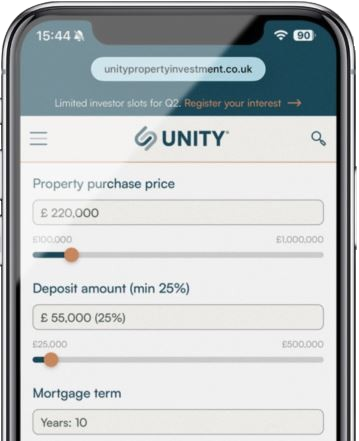
Buy to let investment and rental yield calculator
.png)
Summary of Key Borrowing Factors
Factor
Impact on Borrowing
Case study

- Property Price:£300k
- Mkt Value at purchase:£320k
- Day one equity:£20,000
- Yield:6.8%
- ROCE:30.1%
.avif)