
.jpg)











The South has become a buyer's market. But has it become an investor's market?
Southern England has become a more challenging market for property sellers.
Official data shows average property prices in London falling by 2.5% in the year to June 2026, while prices in the South East increased by just 0.3%. More current asking-price data points in the same direction: Rightmove reported annual asking-price growth of 1.5% across northern England in August, compared with a 1.8% decline across the South.
At the same time, buyers have more property to choose from. Rightmove reported the highest number of homes for sale at this point of the year in 12 years, while Zoopla reported that the stock of homes for sale was around 5% higher than a year earlier.
For anyone trying to buy a home, the implications are relatively straightforward: more choice, less competition and potentially greater negotiating power.
For property investors, however, there is another question to answer.
Our previous Market Intelligence analysis, Rents Outpacing House Prices: UK Rental Yield Outlook, found that rents are now growing faster than property prices across much of the UK. That changing relationship is gradually improving the rental economics of residential property.
But if that trend is combined with a significantly weaker sales market in southern England, has the South now reached the point where it represents a genuine investment opportunity?
The distinction matters.
A buyer's market creates negotiating power. An investor's market requires the numbers to work after the negotiation.
Executive Summary
The evidence points to a clear change in southern England's acquisition environment, but not to a blanket buy signal. London prices are falling, growth across the South East is close to zero, southern asking prices are declining and housing inventory is elevated. At the same time, rents remain high and continue to rise, improving the relationship between income and property values.
For investors, the conclusion is more qualified. Greater buyer choice and weaker seller pricing power create better conditions for finding attractive acquisitions, but regional yield data does not show that the South has suddenly become a high-income market. The investment case depends on the individual property, the negotiated entry price, financing and acquisition costs, sustainable rental demand and any realistic opportunity to add value.
Key takeaways
• Southern England is clearly a buyer's market: price growth is weak, asking prices are falling, stock is elevated and sellers face greater competition for purchasers.
• The evidence only partially supports calling it an investor's market: headline southern yields have improved, but generally remain below northern regional averages and financing/acquisition costs remain significant.
• The strongest opportunity is property-specific rather than regional: investors need to convert greater negotiating leverage into an attractive entry price without compromising rental demand, asset quality or sustainable net returns.
• For income-focused, highly leveraged investors, parts of the North and Midlands may still offer stronger day-one economics; southern opportunities are more likely to suit selective buyers with sufficient capital, a longer horizon or a credible value-add strategy.
The UK property market is increasingly divided North and South
The difference between northern and southern housing markets has become difficult to ignore.
According to the UK House Price Index, average property prices in the North West increased by 4.7% in the year to June 2026, while the North East recorded growth of 4.3%.
The picture becomes progressively weaker as we move south.
The South West recorded annual growth of 1.9%, followed by 1.1% in the East of England and just 0.3% in the South East.
London sits at the other end of the spectrum, with average prices falling by 2.5%.

Buy to let investment and rental yield calculator

The North-South House Price Divide
Annual change in average house prices by selected English region, June 2026.
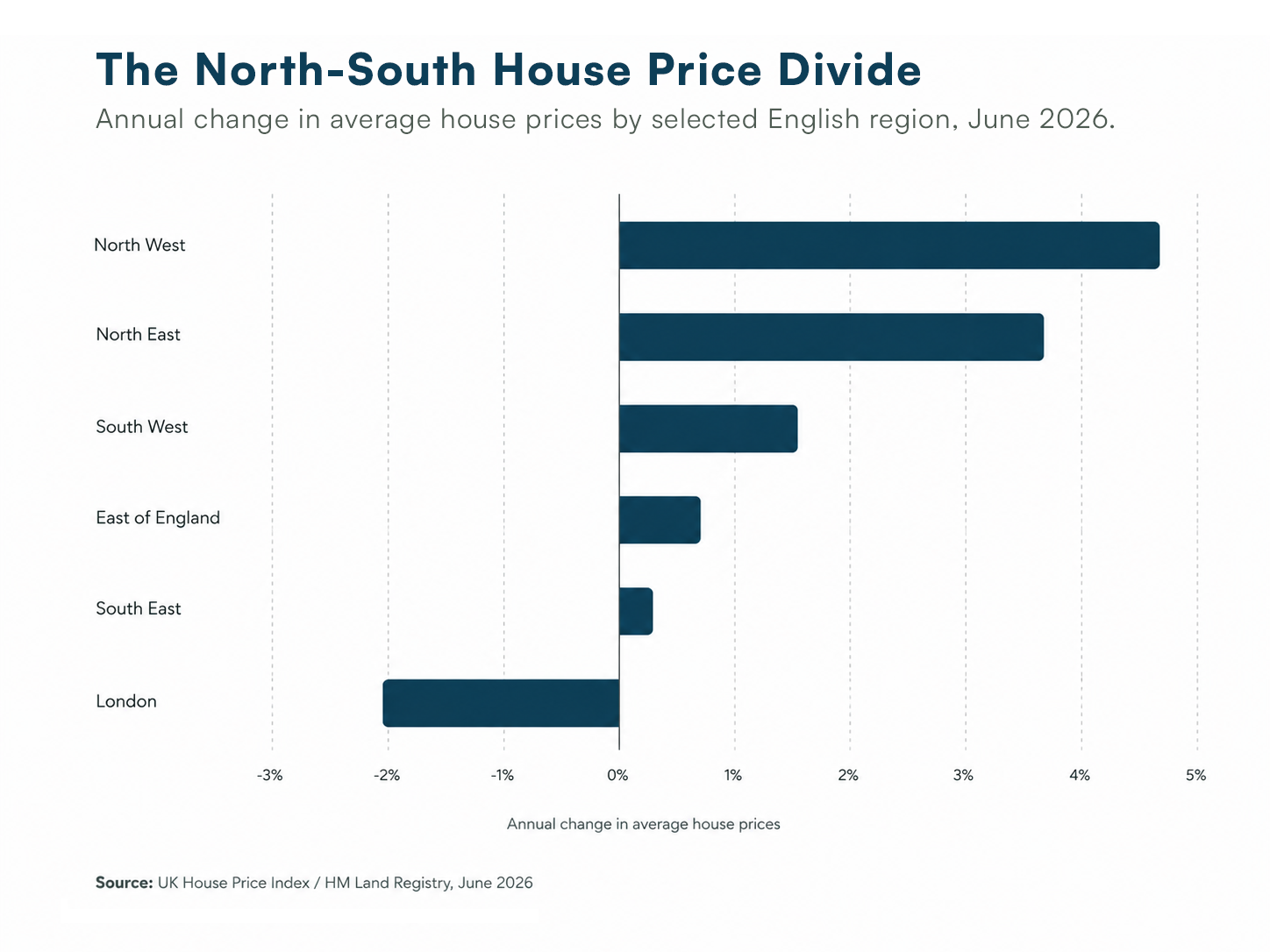
There is an important limitation to these figures. The UK HPI is based on completed transactions and therefore inevitably tells us about deals agreed earlier in the market cycle.
More current asking-price data suggests the divergence has continued.
Rightmove reported that average new-seller asking prices across Great Britain fell 2.0% between July and August 2026. More significantly for investors assessing regional conditions, asking prices were 1.5% higher year-on-year across northern England but 1.8% lower across southern England.
Asking Prices Show the North-South Divide Continuing
Annual change in new-seller asking prices, August 2026.
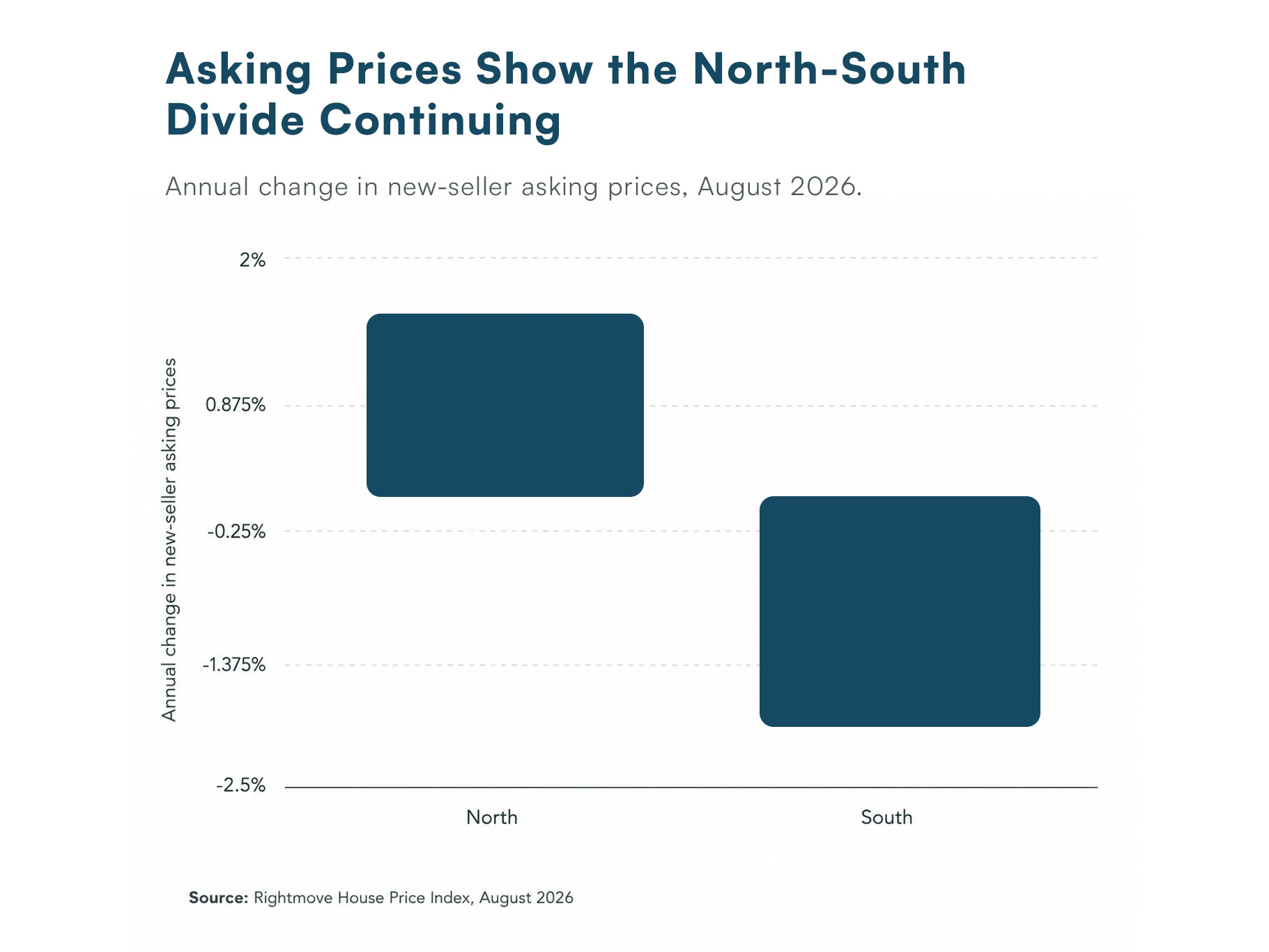
It gives us two different views of essentially the same market divergence.
Completed transaction data shows considerably stronger price growth in northern regions, while asking-price data indicates that sellers in the South continue to face greater pricing pressure.
More homes for sale are changing the balance of power
Price movements alone don't necessarily create a buyer's market.
The other important development is supply.
Rightmove reported a 12-year seasonal high in the number of properties available for sale for the time of year, while Zoopla's August data indicated that the stock of homes for sale was approximately 5% higher than a year earlier.
Meanwhile, transaction activity remains relatively subdued. HMRC recorded 96,710 seasonally adjusted residential transactions in July 2026, 2% fewer than in June and 1% fewer than a year earlier.
That combination matters: more properties competing for buyers + subdued transaction volumes = greater competition between sellers.
For investors, this can materially alter the acquisition process.
In a highly competitive seller's market, an investor may have to decide quickly, compete against owner-occupiers and potentially compromise on price simply to secure a property.
A market with greater inventory offers the opposite advantage.
Investors can compare more properties, reject marginal opportunities, monitor listings that have failed to sell and make offers based on their required investment return rather than fear of losing the asset to another buyer.
There is evidence of sellers adjusting accordingly. Rightmove reported that around 32% of properties for sale had undergone an asking-price reduction.

But that statistic needs to be interpreted carefully.
An asking-price reduction is not the same thing as buying below market value.
A property originally marketed at £400,000 and subsequently reduced to £370,000 has not necessarily become a bargain. The original asking price may simply have been unrealistic.
Nor does evidence of widespread price reductions mean investors can automatically negotiate a particular percentage below asking price.
What has changed is the negotiating environment, not the fundamental rules of valuation.
A buyer’s market creates negotiating power. An investor’s market requires the numbers to work after the negotiation.
A buyer’s market can improve the price you pay. It cannot rescue a fundamentally weak investment.
Why is the South experiencing greater pressure?
One explanation for the divergence is the considerably higher absolute cost of property across southern England.
The average South East property was valued at approximately £380,380 in June, compared with £165,550 in the North East.
Consider the borrowing required at 75% loan-to-value.
The percentage mortgage rate may be identical, but the amount of debt being serviced is clearly not.
That makes higher-priced markets particularly sensitive to affordability constraints. Buyers require larger deposits, larger mortgages and greater incomes to support the borrowing.
Investors face the same issue, alongside higher absolute acquisition costs.
The result is not that southern property must fall in value. Rather, higher-priced markets require substantially more equity and debt for the same percentage LTV, making affordability more sensitive to elevated borrowing costs and limiting the price that many buyers can support.
This helps explain why the current adjustment has been substantially more pronounced in London and parts of southern England than in lower-priced northern markets.
Falling prices, a buyer's market and an investor's market are three different things
This is perhaps the most important distinction for investors.
A falling market means property values are declining.
A buyer's market means the balance between supply and demand gives purchasers greater choice and negotiating power.
An investor's market exists when assets can be acquired at prices that produce attractive investment economics relative to their risks.
The first two do not automatically produce the third.
Consider a property that has fallen from £400,000 to £360,000.
That 10% reduction tells us very little about whether it is now an attractive investment without knowing the achievable rent, operating costs, condition, financing requirement and underlying local demand.
The property may have been overpriced at £400,000. It may have unusually high service charges. Rental demand may be weak. It may require substantial capital expenditure. Or the local market may simply have repriced to reflect deteriorating fundamentals.
Conversely, weaker market conditions can create opportunity when a fundamentally attractive asset becomes available at a price at which the investment mathematics improve.
The relevant question therefore isn't: How much has this property been reduced?
It is: What return can reasonably be generated from the total capital required to acquire and operate it?
That's a much higher hurdle.
Rents are providing some support to the investment case
This is where the sales-market adjustment intersects with the trend explored in our previous Market Intelligence analysis.
While southern property-price growth has weakened considerably, rents have continued to rise.
Annual rental growth reached approximately 2.2% in London, 2.9% in the South East, 3.3% in the East of England and 4.7% in the South West.
We explored the reasons for that divergence - and its implications for yields - in Rents Outpacing House Prices: UK Rental Yield Outlook.
The important point for this analysis is simpler:
Southern investors are no longer necessarily facing rapidly rising acquisition prices at the same time as trying to capture rental growth.
In some markets, property values are broadly flat or falling while rents continue to increase.
That changes the investment equation.
But has it changed it enough?

Are southern rental yields now attractive enough?
Using regional average property prices from the UK HPI and average rents from the ONS allows us to construct a simple indicative comparison.

Portfolio projection tool
These figures should not be interpreted as achievable buy-to-let yields for individual properties.
They combine regional average rents with regional average property values and therefore provide a macroeconomic comparison rather than an investment appraisal.
Nevertheless, they tell us something useful.
The South has not suddenly become a high-yield market.
The indicative South East yield remains around 4.5%, compared with approximately 5.2% in the North West and 5.7% in the North East.
London's calculation is more interesting at approximately 5.0%, reflecting the combination of very high absolute rents and falling average property values. But London is an exceptionally diverse market in which property type, borough, service charges and leasehold costs can radically alter actual returns.
The conclusion is therefore more nuanced than simply declaring the South cheap.
The direction of the investment mathematics is becoming more favourable, but the regional averages do not show a broad income case for reallocating capital from northern to southern property. The evidence supports a selective opportunity rather than a wholesale change in the relative attractiveness of the regions.
Financing remains a major part of the equation
Gross yield is only the beginning of an investment appraisal.
It is also misleading to directly compare, for example, a 5% gross rental yield with a 5% mortgage rate.
Gross yield is calculated against the total property value. Mortgage interest is charged only against the amount borrowed.
An investor needs to model the actual capital structure.
That includes loan-to-value and mortgage interest, lender fees, letting and management costs, maintenance, insurance, void periods, compliance expenditure, service charges where applicable, taxation and SDLT and other acquisition costs.
Acquisition costs are particularly significant in higher-value southern markets.
Investors purchasing additional residential properties currently face higher SDLT rates incorporating the 5% additional-property surcharge. Because the underlying property price is higher in much of the South, the absolute amount of capital consumed by transaction taxes can become substantial.
This means that a modest improvement in gross yield doesn't necessarily translate immediately into an attractive return on equity.
Entry price matters, but so does the amount of capital required to achieve that entry.
Does the North still offer stronger income economics?
On the current regional averages, yes.
An investor whose principal objective is maximising day-one rental income relative to property value can still find a stronger headline proposition in parts of northern England.
Average acquisition prices are considerably lower, indicative gross yields are higher, and both rental and property-price growth have recently been stronger in the North East and North West than in London and the South East.
That is an important conclusion because it prevents the current southern buyer's market being mistaken for an automatic capital-allocation signal.
But it also doesn't mean that every northern property is a better investment than every southern property.
Regional averages conceal enormous variation.
A 5.7% indicative regional yield doesn't tell us about the quality of an individual street, tenant profile, maintenance burden or achievable purchase price.
Likewise, a 4.5% South East regional average doesn't prevent an investor from finding an individual property capable of producing materially stronger economics.
The current market therefore increasingly rewards property-level selection rather than broad regional assumptions.

So where could the southern opportunity actually emerge?
The strongest southern investment opportunities are unlikely to exist simply because a postcode has experienced falling prices.
Instead, investors should be looking for a dislocation between the sales market and the underlying rental fundamentals.
Consider two hypothetical properties.
Both are in areas where house prices have weakened.
The first produces a low yield, has limited rental demand, requires substantial expenditure and offers no obvious route to improving income.
The second sits in an established rental market, has become harder to sell because of weaker owner-occupier demand, can be acquired at a price that produces acceptable starting economics and offers a realistic opportunity to improve the property or rental income.
Both properties exist in a buyer's market.
Only one may represent an investment opportunity.
For Unity, this is where the present market becomes particularly interesting.
Greater inventory gives investors the ability to search for situations where property-specific fundamentals remain stronger than current seller sentiment.
That might mean a property with:
• Strong demonstrable rental demand;
• A realistic rather than aspirational purchase price;
• An acceptable starting yield;
• Manageable ongoing costs;
• Refurbishment or other genuine value-add potential;
• A rent that can be supported by local tenant affordability;
• Sufficient margin to withstand voids, maintenance and financing costs.
Importantly, none of these factors should be assumed simply because a property has been reduced.
The investment case still has to be established property by property.
What could invalidate the southern opportunity?
There is also a credible bear case.
The first risk is straightforward: prices could fall further.
Buying after a price decline does not guarantee that the bottom of the market has been reached.
Secondly, rental growth could continue to moderate. If rents stagnate while financing and operating costs remain elevated, some of the apparent improvement in investment economics could disappear.
Thirdly, transaction costs create a substantial hurdle. SDLT, legal costs, mortgage fees and refurbishment expenditure mean investors require more than a marginal pricing advantage to justify buying and selling property.
Property type matters too.
In parts of London and other southern urban markets, apparently attractive headline yields on leasehold flats can be materially weakened by service charges, insurance costs and major works.
Finally, investors should be particularly cautious about relying on an assumed return to rapid southern capital appreciation.
The current evidence tells us that southern acquisition conditions have improved.
It does not tell us when house-price growth will recover, or that the South will subsequently outperform other UK regions.
Any investment should therefore be capable of standing on its present-day fundamentals rather than depending entirely on a future market rebound.

-v1.avif)
Get investor insights and early access to opportunities
Join our investor briefings for structured insights, market updates, and priority access to new deals.

No spam, just timely insights for investors We respect your privacy and never sell your data
Unity's view: a buyer's market isn't automatically an investor's market
There is little doubt that the balance of the southern housing market has shifted.
Price growth is considerably weaker than in the North. London prices are falling. Southern asking prices are declining. Stock is elevated. Sellers face greater competition.
At the same time, rents remain substantially higher than they were several years ago and continue to grow even as property prices stagnate across parts of the South.
That combination makes southern England more interesting to property investors than it was when acquisition prices were rising more quickly and sellers held greater negotiating power.
But it does not make every southern property or even every southern market attractive.
For an investor prioritising maximum immediate rental yield, parts of northern England continue to offer stronger headline economics.
The emerging southern opportunity is therefore narrower and more selective.
It lies in using greater buyer choice and weaker seller pricing power to acquire the right property at the right entry price, particularly where strong rental fundamentals or a credible value-add strategy can improve the return beyond what regional averages imply.
That requires considerably greater selectivity than simply buying because prices have fallen.
And that is ultimately the difference between the two markets.
Taken together, the research supports a qualified conclusion: the South has clearly become a buyer's market, but it is not yet a broad investor's market for highly leveraged, income-focused buy-to-let. The opportunity is strongest where weaker sales conditions can be converted into a genuinely attractive entry price without compromising rental demand, property quality or the ability to generate sustainable net returns.
A buyer's market gives an investor greater negotiating power.
An investor's market exists only when that negotiating power can be converted into an acceptable return.
On the evidence available in August 2026, southern England only partially meets that test.
Whether an individual property does depends on what you buy, what you pay, the income it produces, the capital required and what can realistically be done to improve the asset after completion.
Methodology note: UK HPI figures reflect completed transactions and therefore lag current market conditions. Rightmove asking-price data measures seller expectations rather than achieved sale prices. ONS rental figures measure the stock of private rents. Indicative yields in this article are macro-level calculations and should not be treated as achievable property-level or net buy-to-let returns.
.png)
Annual House-Price Growth by Selected English Region
Region
Average property price
Annual price change
Source: UK House Price Index / HM Land Registry, June 2026.
Illustrative Borrowing Requirement at 75% LTV
Region
Average property price
25% equity
75% mortgage
Illustrative calculation based on regional average property prices. Excludes SDLT, fees and other acquisition costs.
Indicative Regional Rental Yields and Market Dynamics
Region
Average price
Price growth
Average monthly rent
Rent growth
Indicative gross yield
Source: Unity calculation using ONS private-rent data and UK HPI regional average property prices. Indicative gross yield = average monthly rent × 12 ÷ average property price.
Case study
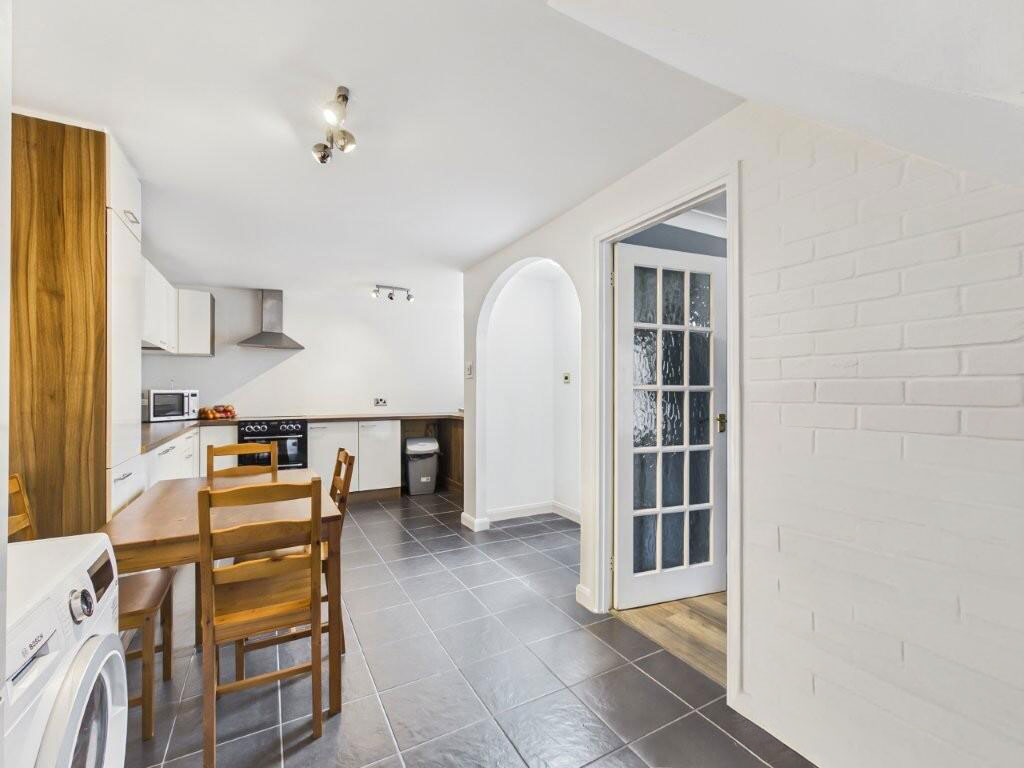
- Property Price:£275k
- Mkt Value at purchase:£290k
- Day one equity:£14,500
- Yield:7.2%
- ROCE:28.6%
.avif)


