
.jpg)









Identifying stronger property investment opportunities requires a systematic approach. There is no single secret source of below-market-value property. Discounts arise from the specific circumstances of a transaction, and a cheap property is not automatically a viable deal.
Finding a lead and appraising it are entirely separate skills. Assessing an opportunity requires establishing its realistic current-condition market value, understanding why the seller may accept less than the maximum achievable price, calculating the total costs required to unlock the property's potential, and projecting achievable rent, financing implications, and likely resale demand.
For a broader explanation of what below-market-value property means, why discounts arise and how investors can acquire from motivated sellers, see our dedicated guide to below market value property.
Executive Summary
This guide provides a structured methodology for sourcing, screening, and appraising discounted investment property in the UK. It demonstrates that finding below-market-value opportunities is not about accessing hidden lists, but rather identifying specific seller circumstances, property conditions, and transaction structures across various sourcing channels. Crucially, it details how to validate an apparent discount to ensure the property represents a sustainable long-term investment once all costs and risks are accounted for.
Key Takeaways
- Asking price is not value: A genuine discount must be assessed against comparable sold evidence rather than the vendor's initial asking price.
- Circumstances create deals: Opportunities typically arise from motivated sellers, broken property chains, condition issues, or a strong preference for transaction certainty.
- Discount does not equal profit: A headline price reduction can quickly be consumed by acquisition fees, short-term finance costs, and necessary refurbishment.
- Appraisal requires full lifecycle modelling: A viable buy-to-let deal requires strong underlying fundamentals, including sustainable rental demand and future resale liquidity, not just a cheap entry point.
What Actually Makes a Property Below Market Value?
To accurately appraise property deals, an investor must separate marketing terminology from actual valuation metrics. A vital conceptual hierarchy to remember is: Asking price ≠ purchase price ≠ current-condition value ≠ post-refurbishment value.
A genuine discount should be assessed primarily against relevant comparable sold evidence, adjusted for the property’s condition and characteristics.
Where Can Investors Find Below Market Value Property in the UK?
Identifying discounted properties requires monitoring multiple channels and understanding the circumstances that can create a pricing opportunity.
Mainstream Property Portals
Standard investment properties for sale advertised on mainstream portals are exposed to the widest pool of buyers, but that does not mean discounted opportunities cannot be found there. Diligent search behaviour can uncover opportunities by monitoring observable indicators:
- Listing age: Extended marketing periods can sometimes create negotiating opportunities, particularly where seller priorities have changed over time.
- Repeated price reductions: May indicate that the original pricing was too ambitious, or that the seller has become more motivated to complete a sale.
- Fall-throughs / "Back on market": When a chain collapses, a seller may prioritise a proceedable buyer to preserve an onward transaction.
- Properties requiring modernisation: Some owner-occupiers may be less willing to take on significant works, potentially narrowing competition.
- Presentation issues: Listings with limited photography, missing floor plans, or tenanted properties where vacant possession is unavailable.
- Probate or executor wording: Circumstances where an executor may value a straightforward transaction.
Estate Agent Relationships
Estate agents remain an important sourcing channel. Agents are motivated by transaction certainty. Following a fall-through, agents may first contact buyers they already know can proceed quickly before beginning a full remarketing process. Accessing these opportunities requires demonstrating clear criteria, realistic pricing expectations, quick feedback, a willingness to walk away from unsuitable deals, and a record of proceeding when an offer is accepted, alongside proof of funds or finance in advance.
Property Auctions
Auctions can be an effective sourcing channel, but an auction listing does not automatically guarantee a discount. The guide price is a marketing tool, not a valuation.
When buying at auction, completion periods are often substantially shorter, meaning funding must be arranged in advance. Investors must rigorously review legal packs before bidding and account for buyer fees and any short-term finance costs where applicable. Competitive bidding can eliminate an apparent discount, reinforcing the importance of setting a maximum offer before bidding.
Repossessions and Lender Sales
Corporate repossessions are often marketed openly, complete with public notices of offer. Transaction circumstances can sometimes create pricing or execution opportunities, but the property still needs to be appraised against genuine comparable evidence. In some circumstances, asset managers may place greater weight on certainty of execution, speed, and the absence of a chain than on a marginally higher offer from a less proceedable buyer.
Tenanted Properties and Landlord Exits
The sale of existing rental properties represents another potential sourcing channel. When landlords exit the market, they often sell properties with a tenant in situ. This can narrow the buyer pool because many owner-occupiers require vacant possession.
Opportunities can arise where the seller prioritises a swift, certain exit over completing required modernisation. In scenarios where rents have fallen below market levels, or where cosmetic upgrades are overdue, there may be a clear value-add case for an incoming investor, provided thorough tenancy and legal due diligence is completed. For more on the wider acquisition thesis from existing landlords, see our guide on below market value property.
Off-Market Property
Off-market transactions occur without public portal advertising, offering sellers discretion and fewer viewings. Opportunities arise through direct professional networks and specialised sourcing channels. For a deeper look at this approach, investors can review our guidance on off-market property.
Probate, Inherited and Motivated Sales
Probate properties are not inherently distressed. However, executors may be managing an empty property and may prefer a straightforward sale rather than undertaking refurbishment before marketing.
Properties Requiring Refurbishment
Refurbishment can create value where the cost of the works is materially lower than the additional rental or resale value generated. Understanding how to model these costs is vital; our breakdown on how we refurbish investment properties explains how to appraise capital expenditure against end value.

Professional Property Sourcing
For those lacking the time to monitor markets and run comparable analysis daily, engaging property investment consultants is an alternative. Professional sourcing can reduce the investor’s workload and provide a more structured approach to screening, appraisal and negotiation, although investors must still understand the underlying investment case and complete appropriate due diligence. Investors can explore how we source properties for a deeper look at this process.
How to Find the Best Buy-to-Let Deals
When searching for buy to let deals, an essential principle is that the best deal is not necessarily the property with the greatest purchase discount. A property bought 5% below market value with strong tenant demand, straightforward finance, predictable maintenance, and broad resale demand can be a stronger investment than a property advertised at a 20% discount with poor liquidity or major defects.
To identify the best buy to let deals UK wide, the evaluation must extend beyond the acquisition price to encompass long-term holding metrics. A structured framework for assessing deals should evaluate the investment on three levels:
Entry
This encompasses the purchase price, total acquisition costs, and the actual capital required to complete the transaction and any immediate works.
Hold
During the ownership period, the property must be sustainable. This means assessing achievable rent, ongoing operating costs, predictable maintenance, the terms of financing, and the underlying local tenant demand.
Exit
The final phase of the investment lifecycle requires broad resale demand, future mortgageability, and overall market liquidity.
The strongest buy-to-let deals are therefore not simply the properties bought at the largest discount, but those where the entry price, rental economics and eventual exit all support the investment case.
The strongest buy-to-let deals are therefore not simply the properties bought at the largest discount, but those where the entry price, rental economics and eventual exit all support the investment case.
Headline discount is not the same as created equity.
How to Appraise a BMV Property Deal Before Making an Offer
Validating an apparent discount requires a structured appraisal process, reliant on empirical data rather than vendor estimates.
1. Establish current-condition market value Do not treat asking prices as evidence of completed market value. Start with recent sold comparables from HM Land Registry for similar properties in similar condition on nearby streets, and use current listings as supporting market context.
2. Adjust the comparables Adjust the baseline data for differences in square footage, condition, parking, outside space, and lease length.
3. Assess current competing stock Review currently available stock. If recent sold data suggests a £200,000 value, but comparable properties are currently struggling to attract buyers at £190,000, this may indicate that current market conditions have weakened and the appraisal should be reviewed.

4. Estimate refurbishment cost Detail the required works schedule. Add a realistic contingency for labour or material overruns to ensure the project remains viable.
5. Estimate realistic post-works value Base this on genuine comparable evidence of fully modernised properties in the same area.
6. Establish achievable rent Use current comparable letting evidence alongside local letting-agent or property-manager appraisals, applying conservative assumptions rather than relying solely on advertised rents.
7. Calculate total acquisition costs Investors should model all acquisition costs, including applicable SDLT, legal costs, surveys, finance costs, broker fees, and any sourcing or auction fees. Current SDLT rates and surcharges for additional dwellings can be verified directly via GOV.UK.
8. Assess financing Buy-to-let lenders assess whether the expected rental income is sufficient to support the proposed borrowing, using their own affordability and stress-testing criteria within the relevant regulatory framework.
9. Assess resale liquidity Evaluate the breadth of the future resale market. A property with strong owner-occupier appeal typically offers greater liquidity than an asset appealing exclusively to cash-buying investors.
10. Derive a maximum sensible offer The offer should be formulated mathematically based on target returns, all-in costs, and realistic post-works value, rather than simply requesting an arbitrary percentage discount.
Note on Valuations: An independent RICS valuation can provide an additional professional assessment of market value. However, valuation remains an informed opinion based on the available evidence rather than an absolute guarantee of the price a property will achieve.
Why Some Discounted Properties Are Cheap for a Reason
A low price may simply reflect risk or cost that has not yet been fully understood. It is vital to run every opportunity through a comprehensive property due diligence checklist.
Issues that can create additional cost, legal complexity, or reduce lender appetite include:
- Structural Defects: Severe subsidence or heave.
- Non-Standard Construction: Concrete or steel-framed properties may affect mortgageability depending on individual lender criteria.
- Leasehold Issues: Short or otherwise problematic lease terms.
- Building Safety: Building-safety or external-wall issues that may affect lender requirements or mortgageability.
- Environmental Risks: Environmental issues such as flood risk or invasive species where these materially affect value, insurance or lender appetite.
Freehold Houses vs Flats When Looking for Discounted Property
Investment analysis shifts according to tenure. Flats can offer attractive entry prices and yields, but require careful consideration of lease lengths, service charges, ground rents, and the potential for major works bills. Reviewing are flats good buy-to-let investments provides a closer look at these variables.
Conversely, freehold houses generally avoid lease-length and ground-rent considerations, although investors still need to assess title restrictions, estate charges where applicable, and take full responsibility for building maintenance. Understanding these leasehold vs freehold buy-to-let considerations is essential when modelling long-term costs.
The Importance of Exit Strategy When Buying BMV
An apparent discount should never be assessed independently of future liquidity. The exit strategy must be formulated before acquisition.
If you needed to sell this property in five years, who would realistically buy it? Investors should consider the breadth of resale demand: would it appeal to owner-occupiers, or only landlords and cash buyers? A property that appeals to both mortgage-funded owner-occupiers and investors may offer a broader resale market. If a property only appeals to a very narrow segment of cash buyers, future resale options may be narrower. A clear understanding of buy-to-let exit strategies ensures the investment case remains sound through to disposal.
A Practical BMV Property Screening Framework
- Establish current-condition market value: Use recent sold comparables, not asking prices.
- Adjust comparable evidence: Account for variations in condition, size, and location.
- Assess competing stock: Review currently active listings.
- Identify why the opportunity exists: Understand whether the pricing is being influenced by condition, tenancy, seller priorities, a failed sale, auction structure, corporate disposal or another factor.
- Estimate refurbishment cost: Use a realistic works schedule plus contingency.
- Estimate realistic post-works value: Base this on genuine comparable evidence.
- Establish achievable rent: Use local evidence and conservative assumptions.
- Calculate total acquisition costs: Purchase price + relevant tax + fees + finance.
- Stress-test the investment: Model the effect of lower rent, void periods, higher costs or changes in financing assumptions.
- Assess resale liquidity: Determine who is likely to buy the property later.
- Derive maximum offer: Derive the offer strictly from the investment case.
Example: Discount Does Not Equal Profit
Headline discount is not the same as created equity. To illustrate why an apparent discount must be comprehensively modelled, consider this simplified scenario:

Portfolio projection tool

The investor has not created £15,000 of additional equity simply because the property was purchased £15,000 below its current-condition value. After £20,000 of works and acquisition costs, the all-in basis is £200,000 against an estimated post-works value of £210,000, leaving approximately £10,000 of potential value uplift before further costs or valuation risk. This demonstrates that actual value creation depends entirely on the all-in cost, time taken, execution risk, and realistic post-works value.
Finding BMV Property Yourself vs Using a Property Sourcing Company
Investors can choose between self-sourcing and using professional services. Both have distinct considerations.
How Unity Approaches Deal Sourcing
The objective is to identify properties where the acquisition price, rental economics, condition, location and eventual exit collectively support the investment case.
Unity does not rely solely on open-market channels. Through our fully owned direct-to-vendor platform, Moov Homes, we source properties directly from motivated sellers who value speed, certainty, and a transparent process over maximising their headline price. This direct approach allows Unity investors to access genuine off-market opportunitiessuch as those resulting from a chain collapse, landlord exit, or the need for a rapid sale before they are exposed to wider market competition and pricing distortions.

Properties sourced through Moov Homes, as well as our other channels, are screened against Unity’s investment criteria before being presented as opportunities. This structured approach is intended to identify properties where the overall investment case remains attractive after costs, refurbishment, rental assumptions and exit considerations are taken into account. Investors interested in seeing how this process works in practice can read how we source properties, or review past case studies detailing acquisition and value-add execution. Investors can also review current investment opportunities that have been assessed against Unity’s investment criteria.
Conclusion
How do you find below-market-value property?
There is no single source. Opportunities emerge from seller circumstances, property condition, transaction structures and sourcing relationships.
However, finding the lead and appraising it are separate skills. The more important ability is determining whether the discount is real, and whether the property remains a viable investment proposition after refurbishment, acquisition costs, finance, rental economics, and exit risks are properly assessed.
Readers can explore Unity's currently available investment opportunities or review how we source properties for a closer look at structured deal appraisal.
Comparison of Self-Sourcing vs. Professional Sourcing
Sourcing Method
Potential Advantages
Potential Considerations
.png)
-v1.avif)
Get investor insights and early access to opportunities
Join our investor briefings for structured insights, market updates, and priority access to new deals.

No spam, just timely insights for investors We respect your privacy and never sell your data
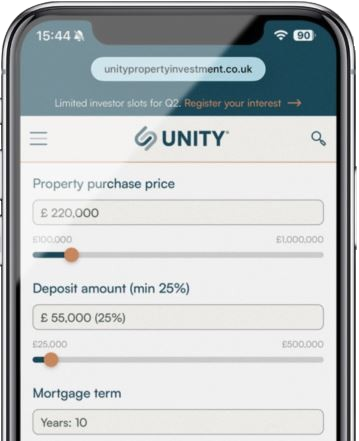
Buy to let investment and rental yield calculator
Property Pricing Terminology and Market Context
Pricing Metric
Definition and Market Context
Frequently Asked Questions
How do you find below-market-value property in the UK?
Where can investors find BMV properties for sale?
Are auction properties always below market value?
What is considered below-market-value property?
How can you tell whether a property is genuinely below market value?
What makes a good buy-to-let deal?
Can you get a mortgage on a below-market-value property?
Case study
- Property Price:£300k
- Mkt Value at purchase:£320k
- Day one equity:£20,000
- Yield:6.8%
- ROCE:30.1%
.avif)