
.jpg)









Selecting a mortgage broker for buy to let is an important decision that influences how a property investment is financed. Rather than acting merely as a conduit to a lender, a proficient broker helps investors identify lenders and mortgage products that align with the specific property, the borrower’s financial profile, the ownership structure, and the overarching investment strategy.
Executive Summary
Buy-to-let financing is frequently more complex than comparing headline interest rates. The cheapest advertised rate is not necessarily the most suitable or cost-effective financing outcome once variables such as rental coverage, required buy-to-let mortgage deposit levels, arrangement fees, fixed-rate periods, and early repayment charges are considered. Furthermore, lender eligibility criteria vary depending on whether the asset is held personally or via a corporate structure, the size of the investor’s existing portfolio, and the physical nature of the property.
This guide examines the role of a buy to let mortgage broker, the potential costs, the regulatory environment, and the framework property investors can use to evaluate and select an appropriate finance professional.
Key Takeaways
- A buy-to-let mortgage broker can help compare lenders, criteria and total financing costs.
- The lowest headline mortgage rate is not necessarily the cheapest overall option.
- Broker market access, specialist experience, fees and lender criteria all matter.
- Specialist expertise may be particularly useful for limited companies, portfolio landlords and unusual properties.
- Mortgage affordability and underwriting criteria vary by lender.
- The mortgage should support the wider property investment strategy rather than dictate it.
What Is a Buy-to-Let Mortgage Broker?
A buy to let mortgage broker acts as an intermediary between a property investor and prospective buy-to-let mortgage lenders. Their primary function is to help secure appropriate financing for a real estate transaction based on an assessment of the borrower’s circumstances.
The process typically begins with evaluating the investor’s available capital, tax bracket, credit history, and long-term objectives. The broker seeks to understand the specific investment requirements, identifying whether the strategy involves standard single-let residential properties, Houses in Multiple Occupation (HMOs), or Multi-Unit Freehold Blocks (MUFBs). By matching the borrower and the property against the nuanced criteria of various high-street and specialist lenders, appropriate broker research may reduce the risk of applying to lenders whose criteria the borrower or property clearly does not meet.
Beyond product selection, a broker compares total financing costs, facilitates the application by packaging the necessary documentation, and manages communication with lender underwriters to progress the case. They can also assist in navigating complex lender criteria, particularly regarding interest coverage ratios (ICR) and stress-testing parameters.
The terms buy to let mortgage broker, buy to let mortgage adviser and buy to let mortgage advisor are often used interchangeably. According to the MoneyHelper service, mortgage advisers and brokers perform the same fundamental job: searching the market to recommend suitable buy to let mortgage advice and deals. However, the market distinguishes between lender-based advisers, who are tied to a single institution and recommend their employer’s specific products, and independent brokers, who can access products from multiple lenders across the market. Where professionals provide regulated mortgage advice, they must hold recognised qualifications, such as a Certificate in Mortgage Advice and Practice (CeMAP), and operate under the oversight of the Financial Conduct Authority (FCA).
Do You Need a Mortgage Broker for Buy-to-Let?
It is not a legal requirement for property investors to use a broker. Borrowers can approach lenders directly, and in certain straightforward circumstances, this direct-to-lender approach is viable. For example, a basic remortgage of a single property with an existing lender, where the borrower requires no additional capital and their financial circumstances remain unchanged, might be executed via an internal product transfer.
However, many investors choose to use buy to let mortgage brokers due to the complexities of the sector. A specialist landlord mortgage broker can offer a wider product comparison, which may include access to intermediary-only products that lenders do not offer directly to the public.
For investors with complex circumstances, such as expatriates, self-employed individuals with fluctuating income, or those purchasing properties like HMOs or flats above commercial premises, specialist expertise may become particularly valuable. Broker assistance is also frequently sought when dealing with corporate ownership structures, multiple properties, and time-sensitive auction transactions where an understanding of lender-specific underwriting can aid in securing funding efficiently. While a broker cannot guarantee a mortgage approval or a better headline rate, they can assist the investor in accessing appropriate financing structures.
Mortgage Broker vs Going Direct to a Lender
Understanding the operational differences between using an intermediary and approaching a bank directly is a core part of financing research. Some mortgage products are exclusive to intermediary panels, while others may only be available directly to consumers.
What Does a Buy-to-Let Mortgage Broker Cost?
Understanding buy to let mortgage broker fees is part of calculating the total capital required to acquire an asset. The cost of advice varies depending on the firm's remuneration model, the complexity of the application, and the loan size.
Brokers are typically remunerated through one or a combination of several models:
- Fee-free to the borrower: No direct fee is charged to the investor; the broker is remunerated entirely by the lender via a procuration fee (commission) paid upon successful completion.
- Fixed fee: The investor pays a set monetary amount for the broker's service regardless of the loan size.
- Percentage-based fee: Often used for complex bridging finance, commercial mortgages, or large multi-unit blocks, calculated against the total loan amount.
- Combination models: Charging an upfront administrative fee while also retaining the lender's procuration commission upon completion.
Investors should establish exactly how a broker is remunerated before proceeding. Regulatory standards require firms to disclose their fee structure and any commissions received clearly.
Crucially, the broker with the lowest upfront fee is not automatically the most suitable option. Compare the broker's cost against the value and suitability of the overall financing solution, rather than simply selecting the broker based on fees alone. A higher broker fee may still represent good value if the broker identifies a more suitable financing structure or helps the investor navigate a complex application.
Headline pricing is of little practical value if the borrower or property does not meet the lender’s eligibility criteria.
A mortgage is a financing tool; it is not the investment itself. Financing should be considered alongside the broader investment strategy, rather than building the strategy around whichever mortgage happens to have the lowest advertised rate.
What Should You Look for in a Buy-to-Let Mortgage Broker?
Evaluating a broker requires assessing their competence, market access, and operational efficiency alongside their fees. The best buy to let mortgage broker for one investor may not be the best choice for another, as lender access, fees, property types, and borrowing structures all affect suitability.
Relevant buy-to-let experience
A professional who mainly handles owner-occupier residential mortgages may lack the specialist experience required for investment finance. Buy-to-let underwriting relies heavily on interest coverage ratios (ICR), projected rental yields, and the applicant's tax bracket. Investors should seek professionals with experience in the specific type of asset being acquired.
Access to the mortgage market
The term "whole of market" indicates that a broker is not tied to a single lender or a highly restrictive panel. However, "whole of market" does not necessarily mean the broker has literal access to every single mortgage product in existence; some lenders operate exclusively through direct-to-consumer models. Nevertheless, a broker with broad market access can provide a comprehensive comparison of specialist and mainstream lenders.
Rather than relying solely on a ‘whole of market’ label, ask the broker which lenders and product ranges they can access and whether there are meaningful parts of the market they do not cover.
Experience with property investors
A proficient property investment mortgage broker understands concepts such as leverage, cash flow, refinancing, and portfolio expansion. They should view the mortgage as a component of a wider investment plan.
Understanding of lender criteria
Headline pricing is of little practical value if the borrower or property does not meet the lender’s eligibility criteria. Specialist knowledge is useful for understanding which lenders accept properties above commercial premises, ex-local authority flats, or specific ownership structures.
Transparent fees
Transparency is an important requirement. An investor should know the exact broker fee, precisely when it becomes payable, whether any portion is refundable, whether repeat fees apply for refinancing, and whether the broker receives lender commission.
Communication and execution
Property acquisitions are frequently time-sensitive. A broker should have robust administrative processes to secure agreements in principle and maintain momentum during the underwriting and valuation phases.
Appropriate regulatory status
The regulatory framework surrounding buy-to-let mortgages is nuanced. A mortgage contract entered into wholly or predominantly for the purposes of a business carried on by the borrower is generally presumed to be exempt from being a regulated mortgage contract under the Financial Conduct Authority (FCA) framework, provided the appropriate declarations are made. However, Consumer Buy-to-Let (CBTL) mortgages, often utilised by individuals who previously lived in the property and are not acting wholly or predominantly for business purposes, fall within a specific regulatory framework designed to provide consumer protection. A broker should hold appropriate regulatory permissions and understand these distinctions where regulated advice is required.
Buy-to-Let Broker Checklist
What Questions Should You Ask a Buy-to-Let Mortgage Broker?
Investors searching for the best buy to let mortgage brokers should focus on suitability rather than rankings alone. To establish whether a finance professional is equipped to handle a transaction, consider asking the following questions during an initial consultation:
- How much of your business is buy-to-let?
- Which lenders can you access?
- Are there lenders or products you cannot access?
- How are you paid, and what exact fees will I pay you?
- When is your fee payable?
- Do you regularly arrange limited company buy to let mortgages?
- Do you work with portfolio landlords?
- How do you compare products with large arrangement fees against lower-fee alternatives?
- How quickly can you obtain an agreement/decision in principle?
- Who manages the case after application?
- What happens when the fixed period ends?
- Can you help with future portfolio refinancing?
Why the Lowest Buy-to-Let Mortgage Rate Isn't Always the Cheapest Deal
Selecting a mortgage based entirely on the lowest advertised headline interest rate is a common error. The total financing cost is the metric that accurately determines the expense of the loan over the fixed period.
Potential costs include the headline interest rate, arrangement or product fees (which can be flat or percentage-based), valuation fees, broker fees, legal costs, and early repayment charges (ERCs).
Consider a simplified illustrative example where an investor requires a £200,000 loan on a 5-year fixed term:
- Product A: Offers a headline interest rate of 4.50% but mandates a 3% arrangement fee (£6,000). Over five years, assuming interest-only payments, the interest totals £45,000, bringing the total financing cost to £51,000.
- Product B: Offers a higher interest rate of 4.90% but charges a standard flat arrangement fee of £995. Over five years, the interest totals £49,000, resulting in a total financing cost of £49,995.
This is a simplified illustration and excludes other potential costs, repayment effects and differences in product terms. In this illustration, the product with the higher interest rate represents a lower total cost. A diligent broker will model these scenarios. For detailed market analysis on pricing structures, investors can review Buy-to-Let mortgage rates.
How Buy-to-Let Affordability Can Affect Your Broker Choice
Affordability assessment is an important part of buy-to-let underwriting. Lenders may assess expected rental income against mortgage interest using an Interest Coverage Ratio (ICR) test.
Stress rates and required ICRs vary by lender, product, borrower circumstances, and potentially by ownership or tax structure. Lenders can take different approaches to affordability; while some rely heavily on rental yield, some lenders may consider personal income in certain circumstances to bridge a shortfall, sometimes referred to as top-slicing.
The Prudential Regulation Authority (PRA) provides an underwriting framework for the sector, but individual lender criteria should not be presented as universal PRA rules. Because lender practices and calculators vary, a broker’s ability to navigate these methodologies is valuable. For a comprehensive breakdown, refer to our guides on buy-to-let affordability and stress testing and how much can I borrow for buy-to-let?
Choosing a Broker for Limited Company Buy-to-Let
The shifting tax environment has led many investors to consider corporate ownership structures. Finding an experienced limited company buy to let mortgage broker can assist investors in navigating this space.
Many lenders offer limited-company BTL lending specifically to Special Purpose Vehicles (SPVs). Lender requirements vary, but criteria may cover company activities, accepted Standard Industrial Classification (SIC) codes (such as 68100, 68209, or 68320 as examples), company structure, and existing trading history. Furthermore, many limited-company BTL lenders require personal guarantees from directors and/or shareholders, although exact requirements vary by institution.
It is important to note that ownership structure should not be selected based solely on mortgage availability. HMRC guidance notes that the restriction on deducting finance costs applies to individual residential landlords, whereas limited companies are subject to corporation tax rules. However, purchasing through a limited company is not automatically more tax efficient; tax outcomes depend entirely on individual circumstances, profit extraction, and capital gains intentions.
A mortgage broker should not be treated as a substitute for personalised tax advice. Investors may need appropriate tax or accounting guidance to determine the correct structure, a topic explored further in our limited company buy-to-let guide and buy-to-let tax explained.
Choosing a Mortgage Broker as a Portfolio Landlord
As an investor scales their holdings, the mechanics of financing shift from assessing individual assets to evaluating wider exposure. A portfolio landlord mortgage broker can assist when borrowing becomes more complex.
Under PRA definitions, a portfolio landlord is a borrower with four or more distinct mortgaged buy-to-let properties. For lenders within the scope of the PRA framework, portfolio landlord applications are subject to a more detailed underwriting approach that considers the borrower’s wider portfolio.
This may involve assessing aggregate rental income, total outstanding borrowing, portfolio Loan-to-Value (LTV), and historical cash flow. Depending on the lender's assessment, the performance and leverage of the wider portfolio may affect borrowing capacity for new acquisitions. A broker experienced in this area can assist with sequencing acquisitions, managing lender exposure limits, and modelling borrowing capacity. For further details on these criteria, refer to our guides for portfolio landlords and professional landlord mortgages.

Portfolio projection tool

What Information Should You Give a Buy-to-Let Mortgage Broker?
To facilitate a smooth process, investors should prepare a comprehensive financial dossier before their initial consultation. Key information may include:
- Income details (salary, dividends, self-employment profits)
- Employment or self-employment status
- Deposit available and proof of source
- Existing mortgages (balances, rates, early repayment charges)
- Existing portfolio schedule (addresses, values, rental income, current lenders)
- Expected rent for the new acquisition
- Property value or purchase price
- Property type and construction
- Proposed ownership structure
- Credit circumstances
- Long-term investment plans
Providing complete information allows the broker to model affordability accurately and identify realistic options.
When Should You Speak to a Buy-to-Let Mortgage Broker?
Ideally, investors should establish their likely financing position before making offers, even if mortgage research and the initial property search happen in parallel. Understanding financing constraints before committing to a property helps prevent delays and ensures the underlying economics of the deal remain viable.
A logical process involves establishing the financing position, confirming borrowing capacity, required deposits, and affordability, before moving to acquisition. This allows the investor to submit offers backed by an agreement in principle. For an overview of how this process operates in practice, review how we work with investors.
How Mortgage Advice Fits Into a Property Investment Strategy
A mortgage is a financing tool; it is not the investment itself. Financing should be considered alongside the broader investment strategy, rather than building the strategy around whichever mortgage happens to have the lowest advertised rate.
When assessing a property, the acquisition price, deposit/equity, rental demand, yield, operating cash flow, refurbishment requirements, and contingency reserves should all be evaluated. Leverage can increase returns on equity when an investment performs favourably, but it also increases financing costs and downside exposure. The financing structure should align with long-term portfolio objectives.
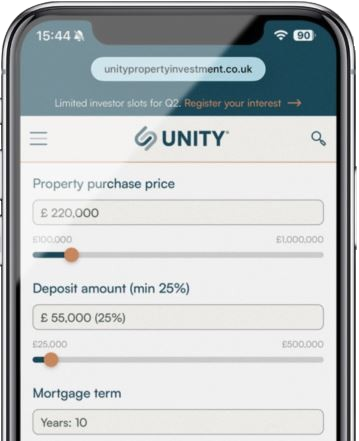
At Unity Property Investment, we focus on property investment strategy, sourcing and acquisition, while appropriate mortgage professionals provide mortgage advice and arrange finance where required. Investors can model long-term scenarios using our buy-to-let calculator and portfolio projection tool, or discuss individual strategy in further detail with our property investment consultants.
Conclusion
Choosing an appropriate buy-to-let mortgage broker requires looking beyond the firm with the lowest upfront fee. A suitable broker should combine relevant buy-to-let experience, appropriate lender and product access, a thorough understanding of the investor’s circumstances, transparent fees, and effective execution.
A mortgage is ultimately a financing tool rather than the investment itself. The underlying property still needs to make sense on its acquisition price, rental demand, yield, cash flow, financing costs and long-term investment case. Choosing an appropriate broker can help ensure the financing supports those objectives rather than constraining them.
To discuss how financing considerations fit into a wider acquisition strategy, book a consultation with our investment team or view investment opportunities available in the market.
Buy-to-Let Broker Evaluation Checklist
What to check
Why it matters
.png)
-v1.avif)
Get investor insights and early access to opportunities
Join our investor briefings for structured insights, market updates, and priority access to new deals.

No spam, just timely insights for investors We respect your privacy and never sell your data
Buy to let investment and rental yield calculator
Buy-to-Let Mortgage Broker vs Direct Lender
Consideration
Buy-to-Let Mortgage Broker
Direct to Lender
Frequently Asked Questions
Is it worth using a mortgage broker for buy-to-let?
How much does a buy-to-let mortgage broker charge?
Can a broker get better buy-to-let mortgage rates?
Do buy-to-let mortgage brokers have access to every lender?
Should I use a specialist buy-to-let mortgage broker?
Can a broker arrange a limited-company buy-to-let mortgage?
Do portfolio landlords need specialist mortgage brokers?
What's the difference between a mortgage broker and mortgage adviser?
When should I contact a buy-to-let mortgage broker?
Case study

- Property Price:£250k
- Mkt Value at purchase:£250k
- Day one equity:£0
- Yield:7.4%
- ROCE:31.6%
.avif)